OSHA COMPLIANCE | HEAT HAZARDS | ISSUED APRIL 10, 2026
OSHA Just Relaunched Its Heat Enforcement Program. Here Is What Small Businesses Need to Know.
Effective today, OSHA’s updated National Emphasis Program on heat hazards is active across every industry, every state, and every worksite—indoors and out. Inspectors are not waiting for complaints. They are coming to job sites proactively. Small and scaling businesses in construction, landscaping, warehousing, trucking, food processing, and a dozen other sectors are on the target list.
On April 10, 2026, OSHA issued CPL 03-00-024—the revised National Emphasis Program (NEP) for Outdoor and Indoor Heat-Related Hazards. The directive takes effect immediately and runs for up to five years. The scope is broad, the enforcement posture is active, and the industries on the inspection target list cover a significant portion of the small and mid-size business landscape.
This post breaks down what the program requires, which industries are in the crosshairs, and exactly what a small crew should have in place before the heat kicks in—or before an inspector shows up.
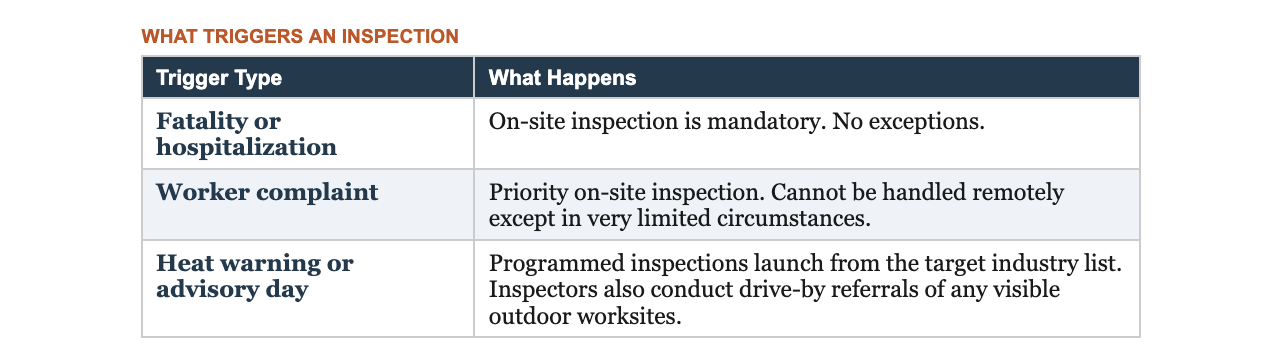
OSHA inspectors are now authorized to stop at worksites they observe while driving past—no complaint required. If the heat index is 80°F or above and workers are outside, that is enough to trigger a visit.
What This Program Is and Why the Revision Matters
BACKGROUND
The original Heat NEP launched in 2022. This revised version updates the target industry list using current BLS and OSHA data from 2021 through 2025, reorganizes inspection guidance for compliance officers, and adds new citation guidance that makes enforcement more consistent across regions.
The numbers behind the program are stark. Between 2021 and 2024, heat exposure caused an estimated average of 3,793 days-away, restricted, and transfer (DART) cases per year and an average of 48 worker fatalities per year. OSHA acknowledges those figures almost certainly undercount the true toll.
Between 2022 and 2025, federal OSHA conducted roughly 2,400 heat inspections per year—including about 50 fatality investigations annually. The revised NEP is designed to drive those numbers down through proactive enforcement, not just reactive response.
Key fact: OSHA heat inspections have accounted for 6 percent of all federal inspections over the last five years. That share is expected to grow under this revised directive.
Who Is Being Targeted
INDUSTRIES ON THE LIST
Appendix A of the directive contains the full target list—55 industries in total, organized by NAICS code. Twenty-two industries are newly added in this revision. The list spans both outdoor and indoor work environments and includes:
- Construction across all trades (residential, nonresidential, highway, specialty)
- Warehousing and storage
- Landscaping, tree removal, and services to buildings
- General freight trucking and couriers
- Animal slaughtering and processing
- Foundries, steel manufacturing, and metalworking
- Automotive repair and maintenance
- Waste collection
- Agriculture and crop support
- Restaurants and food service (newly added)
- Temporary staffing agencies placing workers in high-hazard environments
Inspectors are not limited to these industries. Any worksite with observable heat hazards during a heat warning or advisory day is fair game—even if the inspector was driving to a different location when the crew came into view.

What Inspectors Are Looking For
THE EVALUATION CHECKLIST
Appendix I of the directive contains the evaluation framework inspectors use when assessing a heat program. Every employer with heat-exposed workers should be able to answer yes to each of the following:
- A heat program exists. Whether written or verbal, the program must be effectively communicated to employees—not just posted somewhere no one looks.
- Temperature and workload are monitored. Employers need a method for tracking ambient heat conditions and the physical demands of the work being performed.
- Cool water is accessible. Sufficient amounts, easily reachable, throughout the shift. NIOSH recommends a cup of water every 15 minutes in heat conditions.
- Additional hydration breaks are allowed. Not just scheduled breaks—workers need access to water whenever heat conditions warrant.
- Shaded or cool rest areas are available. A rest area counts. A rest area that takes 10 minutes to reach in 100-degree heat does not.
- New and returning workers are acclimatized. Gradual exposure to heat over several days before full workload. This is non-negotiable in the directive and one of the most commonly cited failures.
- Administrative controls are in place. Earlier start times, workload adjustments, rotation schedules, limiting peak-hour outdoor exposure.
- Training has been delivered. Workers must know the signs of heat illness, how to report symptoms, first aid procedures, and how to contact emergency services.
- Supervisors understand and enforce the program. A designated person is responsible for heat oversight on site.
Acclimatization failures kill people. New hires and workers returning from extended leave are the highest-risk population—and the ones most often overlooked when the schedule is full.
The Legal Mechanism: General Duty Clause
NO HEAT-SPECIFIC STANDARD—BUT CITATIONS ARE STILL REAL
There is currently no federal OSHA standard specific to heat. OSHA is still finalizing the Heat Injury and Illness Prevention rulemaking proposed in August 2024. In the meantime, heat citations are issued under Section 5(a)(1) of the OSH Act—the General Duty Clause—which requires employers to provide a workplace free from recognized hazards likely to cause serious injury or death.
That standard is broad by design. Heat is a recognized hazard. Extreme temperatures are a recognized hazard. Inadequate water, inadequate rest, and failure to acclimatize workers are recognized control failures. OSHA does not need a specific standard to cite—and this directive makes clear that inspectors have the tools, training, and authorization to do exactly that.
Seven states already have heat-specific standards: California, Colorado, Maryland, Minnesota, Nevada, Oregon, and Washington. Employers in those states operate under additional requirements beyond the federal General Duty Clause baseline.
For California employers: Title 8 §3395 (outdoor) and §3396 (indoor) impose specific, enforceable requirements including written procedures, mandatory shade, and cool-down rest periods. Cal/OSHA enforcement under these standards is independent of the federal NEP.
The Small Business Dimension
EXEMPTIONS AND THEIR LIMITS
Small businesses with 10 or fewer employees are partially protected from certain enforcement activities under the annual OSHA Appropriations Act. Small farming operations with 10 or fewer employees and no active temporary labor camp are exempt from programmed inspections entirely.
However, exemptions from programmed inspections do not mean exemption from all enforcement. Complaints, fatality investigations, and referrals can still trigger inspections regardless of headcount. And the exemption threshold is 10 employees—a business with 11 people on payroll has no exemption at all.
More practically: a business that gets inspected because a worker was hospitalized for heat stroke does not get to cite headcount as a defense. The General Duty Clause applies to every employer with employees.
The exemption protects small employers from scheduled, proactive inspections. Nothing protects an employer when a worker ends up in the emergency room.
WHAT SCALING BUSINESSES FACE
For businesses growing from 5 to 25 people, the heat NEP creates a specific operational risk: procedures that worked informally at small scale stop working as headcount and worksites multiply.
At five people, the owner knows every worker’s physical state. The owner knows who just came back from vacation and needs acclimatization time. The owner knows who has a health condition that increases heat risk. That direct knowledge disappears at 15 people across two jobsites—and that gap is where heat incidents happen.
The directive specifically calls out new hires and workers returning from extended leave as elevated-risk populations. As crews grow and turnover increases, tracking acclimatization status becomes a system requirement, not a personal one.
What to Have in Place Before Summer
THE PRACTICAL CHECKLIST
- A written heat illness prevention program. Does not need to be elaborate. Does need to exist, be accessible, and be communicated to every worker before heat season or before first heat exposure—whichever comes first.
- Water, rest, and shade protocols documented. Where water is located. How often breaks happen. Where workers go to cool down. Who monitors conditions. Write this down.
- Acclimatization schedule for new and returning workers. A standard onboarding protocol that reduces workload during the first week of heat exposure, with supervisor checkpoints. Document who has been acclimatized and when.
- Training records. Every worker on the crew needs to be able to demonstrate knowledge of heat illness signs, reporting procedures, and emergency response. Keep a log.
- A designated heat safety lead. Someone on site is responsible for monitoring conditions, checking on workers, and making the call to pull people off work if conditions become dangerous. This person needs to be named and trained.
- Incident and near-miss log. If a worker shows symptoms of heat illness—dizziness, confusion, nausea, cramps—that event gets documented whether or not medical treatment follows. Near-misses are leading indicators. Document them.
- Emergency response plan. Who calls 911. Who meets the ambulance. What information the hospital needs. Where the nearest emergency room is located from each active jobsite.
Documentation principle: If an inspector asks whether workers were acclimatized, the answer ‘yes’ is not enough. The answer needs a name, a date, and a signature. Everything that is not documented did not happen—at least not in an enforcement proceeding.
The Bottom Line
OSHA’s updated heat NEP is not a future concern or a large-employer problem. The directive is active today. The target industries cover a wide swath of small and scaling businesses. Inspectors have clear authority to stop at observable worksites without a prior complaint.
The good news is that compliance does not require a complicated program. Water. Rest. Shade. Acclimatization. Training. A person on site who is responsible. Documentation showing all of the above.
None of those requirements are unreasonable. None of them are expensive. What they require is intention, consistency, and a crew that believes the employer actually means what the program says.
Heat season is coming. The enforcement infrastructure is already in place. The question is whether operations are ready before the temperature climbs—not after a worker goes down.
Source
OSHA CPL 03-00-024, National Emphasis Program – Outdoor and Indoor Heat-Related Hazards. Effective April 10, 2026. Available at osha.gov/sites/default/files/enforcement/directives/CPL_03-00-024_0.pdf