
EHS FOR SMALL BUSINESS | CULTURE
Culture Is Not Just for Big Companies
When you’re running a crew of five to twenty-five, culture sounds like something Fortune 500 companies worry about. That assumption is expensive. The culture a business builds around how work gets done—and how people get treated—is exactly the kind of foundation that determines whether the operation survives scaling, or gets crushed by the attempt.
Here is what happens when small businesses skip building culture: everything runs fine until the whole operation stalls. One incident, one OSHA inspection, one workers’ comp claim—and suddenly a business that was growing has a six-figure problem, a rattled crew, and a reputation too small to absorb the hit.
The good news is that building a strong culture when a business is small is far easier than retrofitting one onto a 200-person operation. The research on what works is clear. And none of the work requires a dedicated safety department or a compliance consultant on retainer.
Strong culture comes down to three things: stabilize what already exists, engage the people doing the work, and make decisions based on what the numbers actually show. Each phase builds on the one before.
The best time to build a strong culture is before one is needed. The second best time is right now.
Step One: Get Stable Before Getting Ambitious
WHY THIS COMES FIRST
Most small business owners who decide to ‘do safety’ make the same mistake: trying to fix everything at once. New forms, new training, new rules, new signage. Within three weeks the crew is overwhelmed, the owner is exhausted, and nothing has changed in practice.
Stability means taking stock of what already exists—and making sure existing systems work—before adding anything new. That includes OSHA recordkeeping, incident response process, basic hazard communication, and emergency contacts. None of these need to be complicated. Each one needs to exist and be used consistently.
This phase matters for trust. When a crew sees existing systems treated with consistency and seriousness, people start to believe safety is real here—not just a mood that shifts with the workload. That belief is the foundation everything else gets built on.
WHAT TO DO
- Walk through current safety practices plainly. What exists? What gets used? What exists on paper only?
- Identify the two or three highest-risk activities in the operation and confirm a clear, current procedure exists for each.
- Make sure every person on the crew knows exactly what to do when someone gets hurt—not just where the first aid kit lives, but who calls 911, who notifies ownership, and who documents the incident.
- Launch nothing new until the basics are solid. Credibility first.
Step Two: Make Safety a Crew Problem, Not a Boss Problem
WHY ENGAGEMENT IS THE MULTIPLIER
Small crews see everything. People know which shortcuts get taken, which equipment is acting up, which tasks feel wrong. When crew members stay quiet about hazards, silence is rarely about not noticing. Silence comes from not believing anything will change—or from worry about how raising a concern will land.
Psychological safety—the belief that speaking up won’t result in punishment or dismissal—is the single biggest driver of whether hazards get reported before becoming incidents. Research from organizational psychologist Amy Edmondson found that teams with high psychological safety catch more errors, report more near-misses, and learn faster. Those findings hold in construction, manufacturing, and field service environments.
For a small crew, building that environment doesn’t require a formal program. Consistent behavior from the person at the top is what shapes the culture—not a policy document.
Workers frequently normalize unsafe practices. People aren’t hiding problems to be difficult—they’re waiting to see whether raising problems is actually safe.
WHAT TO DO
- When someone reports a problem, offer thanks out loud—in front of others. Then follow through. If a fix can’t happen immediately, say when the fix will happen.
- At least once a month, walk the worksite with the crew specifically to look for hazards. Not to check productivity—to find problems. Ask what feels off. Listen without defending.
- When a near-miss happens, talk about the event openly: what occurred, what could have happened, what changes as a result. Normalizing the conversation is the work.
- Never penalize someone for raising a safety concern. When a concern turns out to be a non-issue, say so clearly—then thank the person for raising the flag anyway.
Step Three: Measure the Right Things—Before Someone Gets Hurt
THE DIFFERENCE BETWEEN LAGGING AND LEADING INDICATORS
Most small businesses only track safety after something goes wrong—an injury, a claim, an inspection. Those are lagging indicators. Lagging indicators measure outcomes that have already occurred. They are useful for spotting patterns over time, but by definition they arrive too late to prevent the incident that generated them.
Leading indicators measure the conditions and behaviors that precede incidents. Tracking leading indicators gives a business the chance to intervene before anyone gets hurt. That distinction—reactive measurement versus predictive measurement—is one of the most important concepts in modern safety management, and small businesses rarely apply it because no one has explained what leading indicators look like at their scale.
Lagging indicators tell you what happened. Leading indicators tell you what is about to happen—if nothing changes.
LAGGING INDICATORS: WHAT TO TRACK
Lagging indicators are outcome-based. For a small business, the core lagging indicators are: total recordable incident rate (TRIR), lost-time incident rate, near-miss count per month, and workers’ compensation claim frequency. These numbers tell the story of what has already happened in an operation—and comparing those numbers year over year shows whether the trajectory is improving.
OSHA requires employers with ten or more employees to maintain a 300 log. For businesses below that threshold, keeping a simple incident record is still best practice—both for internal learning and for demonstrating due diligence if questions arise later.
LEADING INDICATORS: WHAT TO TRACK
Leading indicators are behavior- and condition-based. The goal is measuring the activities that predict safety outcomes before those outcomes materialize. For a small crew, the most actionable leading indicators are: near-miss reports submitted per month, percentage of safety training completed by the crew, corrective actions identified and closed, and hazard inspection completion rate.
Near-miss reporting is especially powerful because a near-miss is a free lesson. Something almost went wrong—and the crew has the opportunity to understand why and change the conditions before the next close call becomes an actual injury. Research consistently shows that organizations with high near-miss reporting rates have significantly lower serious injury rates. The reporting itself is the leading indicator. Low near-miss numbers in a busy operation are not a sign of good safety—they are a sign that reporting is not happening.
Rule of thumb: For every serious injury, research suggests there are roughly 30 minor incidents and 300 near-misses. If near-miss numbers are low but the work is genuinely hazardous, the near-misses are happening—they’re just not being reported.
PUTTING BOTH TOGETHER
Neither lagging nor leading indicators work well in isolation. A business tracking only injury rates is always looking backward. A business tracking only leading indicators without accountability for outcomes can lose sight of whether the effort is working. The most effective approach combines both: use leading indicators to manage proactively, and use lagging indicators to audit whether proactive efforts are producing results.
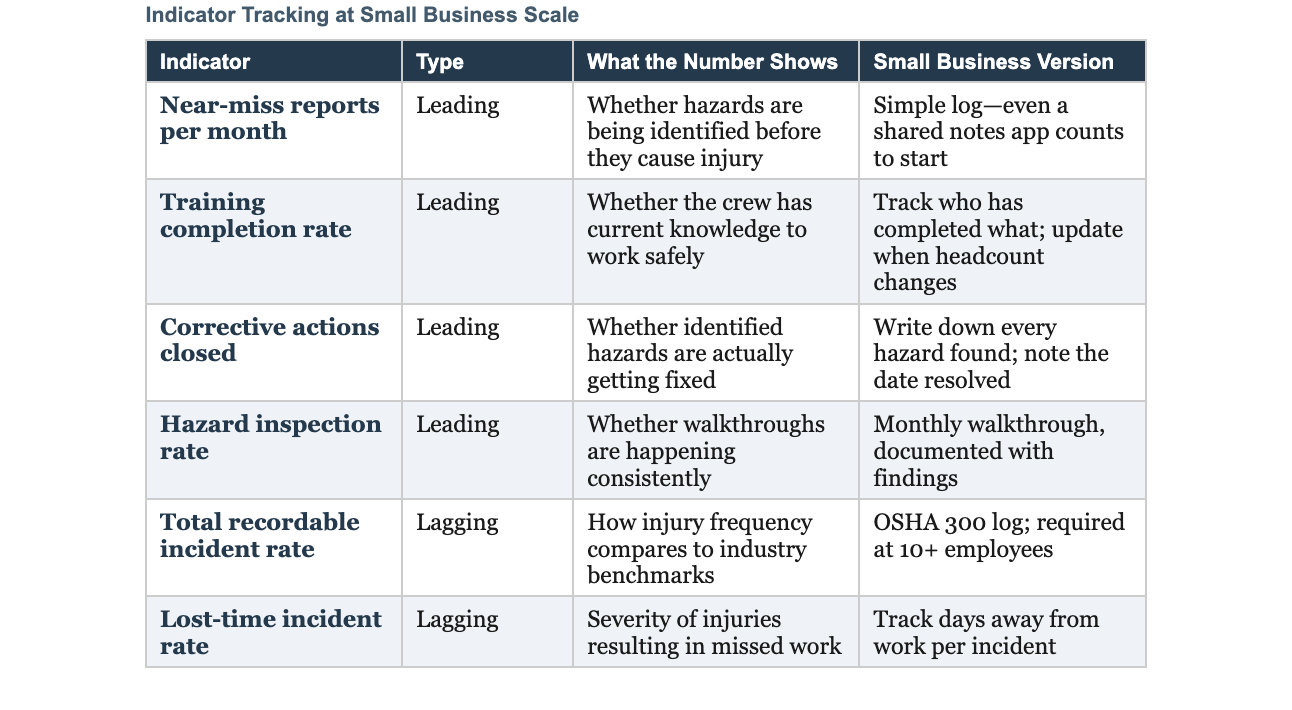
The goal is not a sophisticated dashboard. The goal is visibility. When patterns become clear—where near-misses cluster, which tasks generate the most corrective actions, whether training is staying current—decisions get made before problems compound.
ONE RULE THAT CANNOT BE SKIPPED
Collect data and act on the data—every time. When a crew submits near-miss reports and nothing changes, reporting stops. Close the loop visibly. A brief ‘we found four hazards last month, here is what changed’ communicates that the system functions. That communication is as important as the data collection itself.
What Changes When the Business Starts Scaling
Going from 5 to 15 to 25 people is not just a headcount change—the trust architecture of the business changes entirely. When the operation is small, culture lives in direct relationships. Everyone knows what the owner expects because they see the owner every day.
As headcount grows, that dynamic stops working. New hires don’t carry the context the original crew holds. Supervisors start making calls without the owner present. Worksites multiply. The informal systems that held things together start showing gaps—and those gaps are where incidents happen.
Businesses get hurt at this stage not because anyone stopped caring, but because the practices that worked informally at five people were never designed to transfer. What was a shared understanding becomes an assumption. And assumptions are where injuries begin.
At five people, culture is a habit. At twenty-five, culture needs to be a system.
WHAT TO BUILD AS THE TEAM GROWS
- A written onboarding checklist covering safety basics for every new hire—completed before equipment gets touched or any task begins.
- Clear expectations for supervisors and leads: responsibility for raising hazards, responsibility for near-miss reporting, and a firm line against pressuring crew members to skip safety steps to hit a deadline.
- A regular cadence—monthly at minimum—where safety performance gets reviewed by whoever runs the business. Not delegated away. Owned at the top.
- Documentation that travels with the work, not just sits in a binder at the office. Job hazard analyses, PPE requirements, emergency contacts—crew members need access on site, not in a filing cabinet.
The Bottom Line
Culture is not a compliance exercise. A workplace culture is not a poster on the wall or a sign-off sheet in a drawer. Culture is the answer to a question every crew member is always asking: does this company actually care what happens to me?
When the answer is yes—backed up by consistent behavior, real follow-through, and a willingness to hear hard things—people work differently. Problems get reported. Crew members look out for each other. People stay.
When the answer is unclear or no, silence fills the space. And silence is where incidents live.
No safety department is required to build this. The work starts with a handful of practices, applied consistently, beginning with what already exists right now.
Further Reading
Research informing this post includes Chaudhary (2026) in Professional Safety Journal, Edmondson (1999) on psychological safety and team learning, Kotter (2012) on organizational change capacity, and standards from OSHA, ISO 45001, and ANSI/ASSP Z10-2019.