
Southern California Edison’s Countdown to 2045 analysis projects that California must add 20,000 miles of high-voltage transmission, 85 new distribution substations, and over 1,400 new distribution circuits—all at four to ten times the historical buildout rate. That is not an infrastructure story. That is a workforce story. And right now, the workforce protection systems are not keeping pace.
California has committed to carbon neutrality by 2045. The legislation is signed. The modeling is done. The numbers are staggering: electricity demand rising more than 80 percent, utility-scale clean energy capacity tripling, and a grid expansion unlike anything the state has attempted before.
Most of the conversation around this transition focuses on megawatts, permits, and policy timelines. Almost none of the conversation focuses on the crews who will physically build all of this—the lineworkers, utility contractors, solar installers, substation construction teams, and support trades who will spend the next two decades working in some of the highest-hazard conditions in any industry.
That gap is the problem. And closing that gap is the work.
California must add transmission infrastructure at four times the historical rate. The workforce executing that buildout will be larger, faster-cycling, and more exposed than any utility construction workforce the state has seen before.
The Scale of What Is Being Built
WHAT THE NUMBERS ACTUALLY MEAN
The Edison Countdown to 2045 white paper is a utility planning document. Read as a workforce document, the numbers look different.
Adding 20,000 circuit miles of 500kV transmission means tens of thousands of lineworkers, equipment operators, civil crews, and specialty contractors working across some of the most remote and climatically extreme terrain in the western United States. Adding the equivalent of 85 new distribution substations in the SCE service area alone—plus upgrades to 350 existing ones and 1,400-plus new circuits—means sustained construction activity at scale across Southern California for the next 20 years.
Total investment: $370 billion or more in transmission, distribution, and utility-scale clean energy. That capital flows through contractors. Those contractors employ crews. Those crews face hazards every day.
For context: CAISO system capacity has grown by roughly 2 gigawatts per year over the last two decades. Countdown to 2045 requires 8 gigawatts per year through 2045. The workforce required to deliver that pace does not yet exist at scale.
Recruiting and ramping a workforce that fast creates a predictable hazard profile: large numbers of newer workers, compressed training timelines, unfamiliar equipment, unfamiliar terrain, and supervisors stretched across more crews than they can closely monitor. That profile is where incidents cluster.
The Hazard Profile of Utility Construction Work
WHAT THE DATA SHOWS
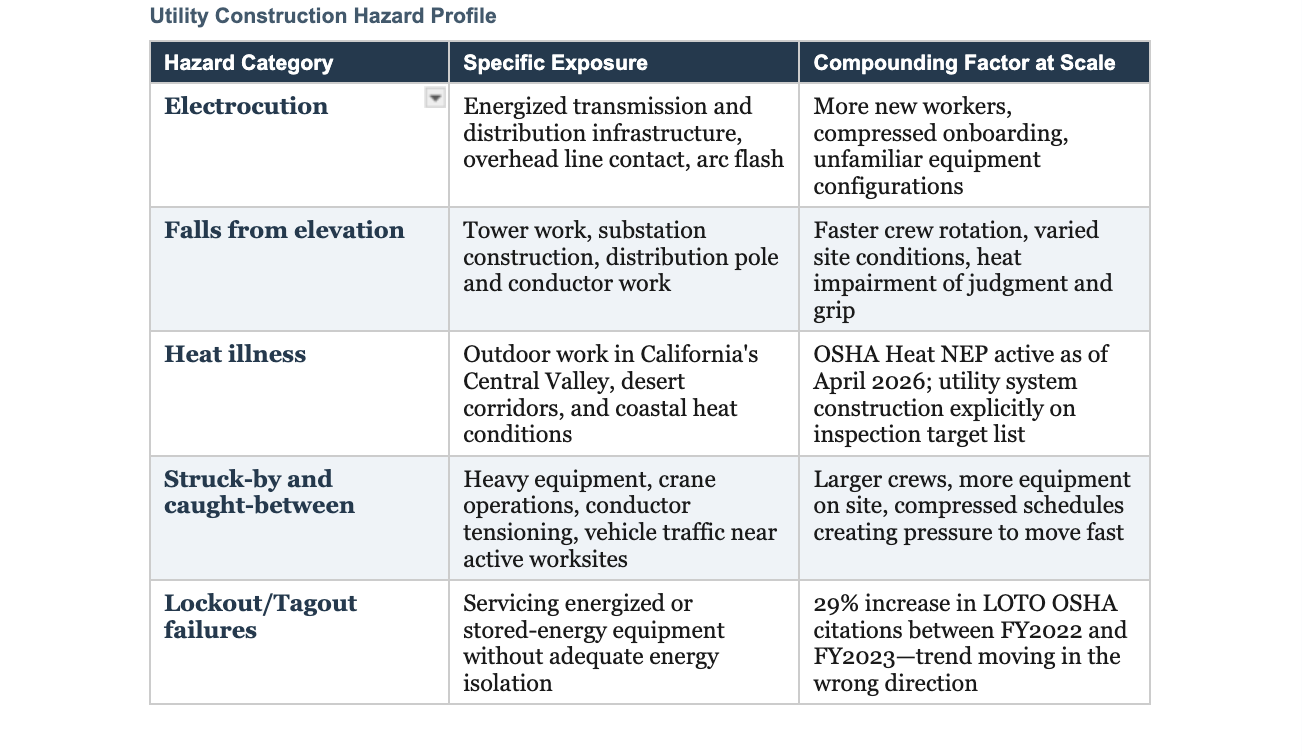
Utility construction work concentrates several of the most serious hazard categories in any industry into a single workforce.
Electrocution remains one of the leading causes of construction fatalities nationally—historically accounting for roughly 8 to 9 percent of all construction deaths annually. Overhead power line contact alone accounts for nearly half of all workplace electrical fatalities. The work of expanding a grid, by definition, puts crews in proximity to energized infrastructure constantly.
Non-fatal electrical injuries involving days away from work rose 59 percent between the 2021–2022 reporting period and the 2023–2024 period, according to the Electrical Safety Foundation International. That increase is happening as the buildout is just beginning. Lockout/tagout violations—the procedural control designed to prevent contact with energized equipment—increased 29 percent in OSHA citations between fiscal years 2022 and 2023.
Falls remain the leading killer in construction overall, with construction workers accounting for approximately half of all fatal occupational falls nationally. Substation work, tower erection, and transmission line installation all involve sustained elevated-work exposure. Heat exposure compounds every elevated risk: judgment degrades, grip strength declines, and situational awareness narrows as core body temperature rises.
Younger and newer workers experience electrical fatalities at 2.3 times the rate of experienced workers. A workforce scaling rapidly is, by definition, a workforce that skews new.
THE COMPOUNDING FACTORS
The Workforce Gap Nobody Is Talking About
SCALE CREATES NEW EXPOSURE
The utility construction workforce that will build California’s grid expansion does not yet fully exist. Utilities, contractors, and labor organizations are actively working to recruit and train the lineworkers, electricians, and specialty tradespeople the buildout requires. That recruitment and training pipeline is necessary. What often gets skipped in the urgency of ramp-up is the parallel investment in the supervision, documentation, and crew-level protection systems that keep a fast-scaling workforce alive.
The hazard pattern in a fast-scaling workforce is consistent across industries: the incident rate rises before the training rate catches up. New workers make unfamiliar decisions in unfamiliar conditions. Supervisors who would otherwise provide close oversight are spread across multiple crews. The informal knowledge transfer that makes experienced crews safe—the crew member who knows to check twice, the foreman who can read when someone is too hot to work—does not transfer automatically to new hires.
California’s grid buildout will almost certainly involve significant use of subcontractors and temporary labor as demand surges. NAICS 5613, Temporary Help Services, is already on OSHA’s Heat NEP target list specifically because temporary workers are placed into high-hazard environments without the host employer’s safety protocols fully applied. The same dynamic applies to electrical and utility hazards.
The informal knowledge that makes experienced crews safe does not transfer automatically. At scale, what kept five people safe becomes an assumption that breaks down across fifty.
WHAT UTILITY CONTRACTORS SPECIFICALLY FACE
For utility contractors—the businesses that prime contractors, municipalities, and IOUs rely on to execute field work—the workforce protection challenge has a specific shape. Many are small to mid-size operations, often 15 to 100 field personnel, scaling quickly to meet demand. Crews are geographically dispersed. Hazards change by job type, by site, and by season. Training records and incident documentation are often managed informally.
That informal management works until a serious incident triggers an OSHA inspection. At that point, the question is not whether the crew was told to work safely. The question is whether the employer can demonstrate—with documentation—that specific workers received specific training, that hazard assessments were conducted for specific job tasks, that acclimatization protocols were followed for specific new hires, and that LOTO procedures were verified before specific equipment was serviced.
Without that documentation, the answer to every OSHA question is no.
What a Protection System Looks Like for Utility Crews
THE FOUNDATION
Protecting utility construction crews starts with the same framework that applies to any field operation—stabilize, engage, measure—but applied to the specific hazard profile of grid work.
- A written job hazard analysis for each task type. Energized work, elevated work, excavation, crane operations, and confined space entry each require a documented hazard assessment before work begins. These do not need to be elaborate. They need to exist, be task-specific, and be reviewed with the crew before the work starts.
- An electrical safety program aligned with NFPA 70E. For any crew working near or on electrical infrastructure, NFPA 70E compliance is the baseline. That means arc flash risk assessments, appropriate PPE categories documented and enforced, energized work permits where required, and LOTO procedures verified—not assumed—before equipment is touched.
- A heat illness prevention program active from April through October. OSHA’s Heat NEP lists utility system construction as a target industry. Utility support activities appear on the same list. A written heat program, acclimatization protocols for new and returning workers, water and shade access documented by site, and a designated heat safety lead on every crew are the minimum.
- Fall protection planning specific to the work, not generic. A fall protection plan that says ‘use harnesses when working at height’ is not a fall protection plan. Crew-specific plans identify the elevated work tasks, the anchor points, the equipment required, the rescue procedures, and the training records proving each worker has been trained for those specific conditions.
- Onboarding documentation that travels with the worker, not the employer. In a subcontracting environment, individual workers may cycle across multiple employers in a single season. Training records, certifications, and medical clearances that live only in a single employer’s filing system are functionally invisible when that worker shows up on a new site. Portable documentation—whether paper or digital—closes that gap.
- Near-miss reporting treated as a leading indicator, not a liability. A crew that reports near-misses is a crew that is paying attention. A crew that never reports near-misses on a job site with active electrical, elevated, and heat hazards is not a safe crew—the reporting has stopped. Building a reporting culture where near-misses generate action, not punishment, is the single highest-leverage intervention available.
On LOTO specifically: A 29 percent increase in OSHA lockout/tagout citations over a single year—tied to $20.7 million in penalties in FY2023 alone—means LOTO is an active enforcement priority, not a background standard. Any utility contractor whose LOTO program exists only on paper is operating with a significant exposure.
The Opportunity in the Buildout
WHY THIS MOMENT MATTERS
California’s grid expansion is a genuine opportunity for the utility construction industry to build a workforce protection infrastructure that matches the scale and permanence of the work being done.
The contractors who establish strong crew-level protection systems now—before the full ramp-up, before the workforce triples, before OSHA’s targeted inspections expand across the industry—will have a competitive advantage that compounds over time. Workers stay. Incident costs stay low. Primes and IOUs increasingly require demonstrated safety performance as a contract qualification. Insurance costs reflect actual loss history.
The contractors who treat crew protection as a compliance exercise—something to paper over before an inspection—will face a different trajectory. A single serious incident at the pace this buildout requires can interrupt operations, trigger multi-site inspections, generate regulatory scrutiny, and damage the contractor relationships that determine who gets the next contract.
The buildout is happening regardless. The workforce protection gap is a choice.
The contractors who build real crew protection systems now—before the workforce triples—will be the ones still operating at full capacity in 2035.
The Bottom Line
California’s path to carbon neutrality runs through the hands of the people building the grid. Twenty thousand miles of transmission. Eighty-five new substations. Fourteen hundred new circuits. A workforce scaling faster than the training pipeline can currently support.
The hazards are known: electrocution, falls, heat, struck-by incidents, and lockout/tagout failures—all in concentrated form, all in a workforce that will include a significant share of newer workers making unfamiliar decisions in unfamiliar conditions.
The protection systems that address those hazards are also known. Written hazard assessments. Electrical safety programs built to NFPA 70E. Heat illness prevention active from April through October. Fall protection specific to the tasks. Onboarding documentation that transfers with the worker. Near-miss reporting treated as intelligence, not liability.
None of that is complicated. All of that requires intention. And the window to build those systems into the foundation of this workforce—rather than trying to retrofit them after the first serious run of incidents—is right now.
Sources
Edison International, Countdown to 2045: Realizing California’s Pathway to Net Zero (September 2023). BLS Census of Fatal Occupational Injuries, 2023 and 2024. BLS Fatal Work Injuries in California, 2024 (April 2026). Electrical Safety Foundation International, Workplace Injury and Fatality Statistics (2026). OSHA Heat NEP CPL 03-00-024 (April 10, 2026). Grace Technologies, 2024 State of Electrical Safety Report.